
The cruelest card in poker
The Super High Roller Bowl has served up plenty of gut-punches, but the one-outer that cracked Alex Foxen on the bubble of SHRB XI belongs near the top. Here’s my take, and I’m not softening it: this is about as brutal as a tournament exit gets, and the damage didn’t stop at one player. It hit two. Same last name. Same household.
If you missed it live, here’s the shape of it. Foxen had a commanding chip lead and was tracking toward a serious result. Nick Petrangelo got it in behind, needing the last remaining six in the deck to beat Foxen’s tens. It came. One card - the only card - and the tournament flipped.
Across the room, Kristen Foxen was the short stack, watching the bubble play out and, by all accounts, thinking she’d just backed into the money. When the six hit, her payday evaporated right alongside her husband’s lead. One card. Two Foxens. No cash.
Why a one-outer on the bubble hits different
A bad beat stings most when it carries consequences beyond the pot. This one carried a bagful.
Look at the variance. Petrangelo was drawing to a single out - about as thin as it gets without being dead. Run that spot a thousand times and almost every version ends with Foxen stacking up and carrying a mountain of chips deeper into the event. Instead, the one scenario where it all collapses is the one that showed.
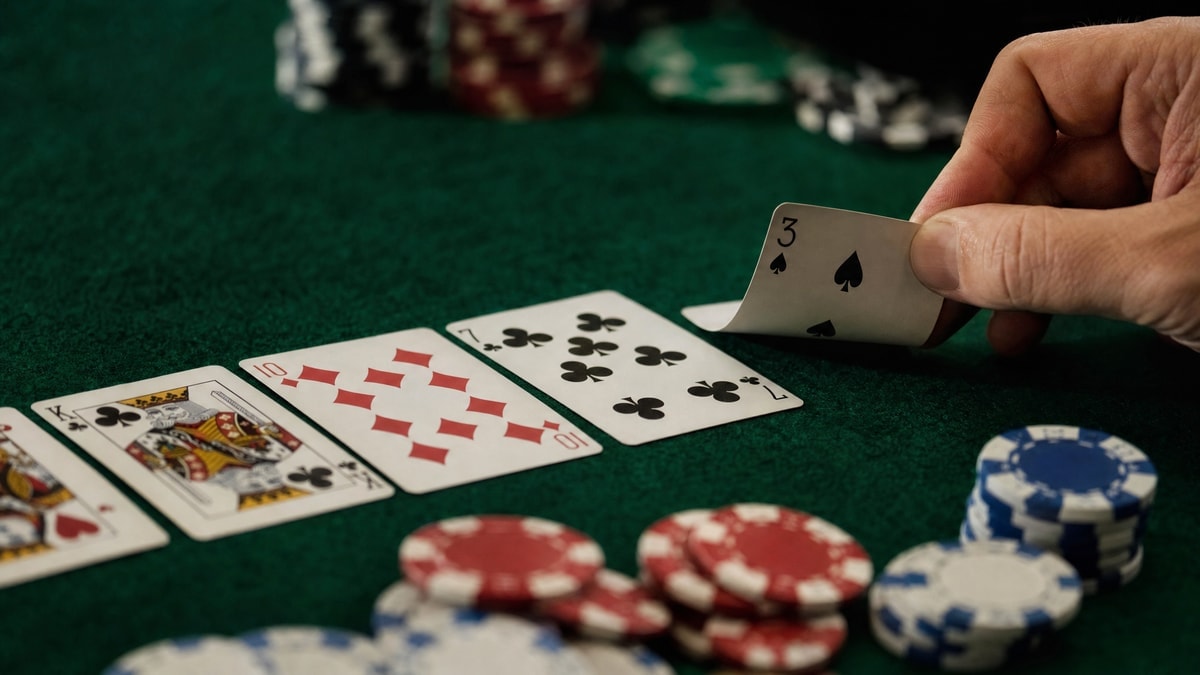
And here’s where it stops being a math problem. Players talk about variance like it’s weather - something you endure, something that evens out eventually. It doesn’t feel like weather when you’re standing in the storm. And when the same card knocks out your partner’s bubble shot too, the abstraction falls away. It becomes a conversation you take home.
The commentary that said the quiet part out loud
PokerGO’s Ali Nejad caught the double-whammy in real time. “A brutal one for Alex,” he said, “and for that matter Kristen, who certainly post-flop thought she was going to sneak in the money.”
That’s the whole thing in one sentence. The brutality wasn’t just that Foxen lost - it’s that the loss had collateral damage. Kristen had already, in her head, done the math on the bubble. Nejad noting that she “thought she was going to sneak in” is the detail that turns a cooler into something worse. There’s a difference between losing and being robbed of something you’d already counted as yours.
I’ll say it plainly, because readers always ask: I’m not putting a dollar figure on what Kristen would have made. The numbers floating around aren’t nailed down, and I’d rather leave it out than quote something I can’t stand behind. The point isn’t the exact amount. The point is that it was real, it was close, and it vanished on one card.
The honest counterargument
Let me be fair, because I can already hear the solver crowd typing. The counter is simple: this is just poker. Petrangelo got it in bad, the cards don’t know whose name is on the stack, and play enough of these and you’ll sit on both sides of it. Foxen knows that better than anyone.
And it’s true. Nobody did anything wrong, the chips went where the deck sent them, and everyone re-buys and runs it back. The Foxens have had plenty of bright moments on the felt - they won five of seven events at the U.S. Poker Open, and Kristen recently grabbed her sixth WSOP bracelet. The variance cuts both ways, and it’s cut generously in their favor more than once.
But here’s my pushback: calling it “just poker” doesn’t make it less brutal. It makes it more so. The game is built to let a one-outer undo an afternoon of flawless play. That’s not a flaw. That’s the whole terrifying appeal.
What I keep coming back to
The part that sticks isn’t the hand - it’s the symmetry. Two elite players, married, in the same event, both wiped out by the same card for different reasons. One lost a lead. One lost a payday. Neither did anything but run into the exact wrong corner of the deck.
That’s the pull of high rollers, and it always has been for me. Not the money - moments exactly like this, where the game does something no screenwriter would dare pitch because it’s too on-the-nose. A one-outer, on the bubble, against the chip leader, whose wife is short-stacked and praying for the money.
You can’t script that. You can only sit there, like Nejad did, and reach for the one word that fits.


